
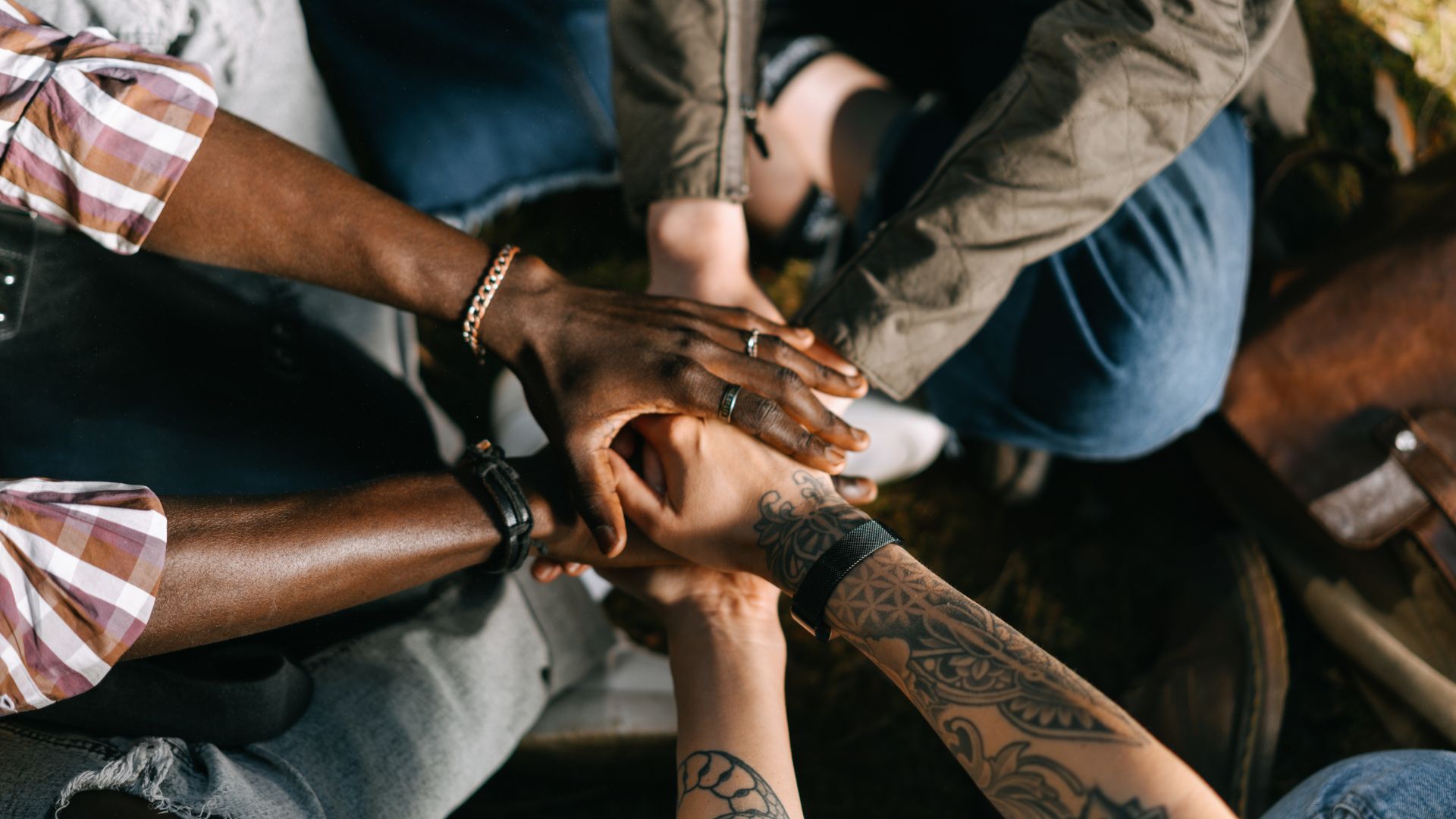
People devoted to peace do not always agree on how to create it. They disagree about methods and priorities. They become protective of organizations and initiatives they have poured themselves into. Funding and recognition can complicate relationships. Feelings are hurt. Frustrations build. Sometimes, Ben Bowler says, “somebody’s logo is not the right size .”
“And then, boom, that’s it. You know, I’m never working with them again.”
Ben has watched versions of this unfold over years of bringing people together across organizations, cultures, faiths, and traditions. As executive director of UNITY EARTH, a global network focused on unity, purpose, and peace, he has helped convene interfaith and intercultural gatherings, global peace initiatives, World UNITY Week, and collaborations among organizations working toward a more peaceful and connected world. Much of that work has meant learning collaboration by actually attempting it—with all the competing priorities, limited resources, and human complexity that entails.
Along the way, Ben has learned that bringing people together is one thing. Learning how to remain together is another.
“I think the value that’s most important is just a refusal to take the bat and ball and go home,” he says.
For Ben, the practice continually returns to something much more intimate: what happens between human beings when we disappoint, frustrate, misunderstand, or disagree with one another.
Ben has come to measure the success of collaborative work accordingly. After a major event, he says, reaching 10,000 people—or even a million—is not the most important measure.
“What’s more important is how we as a collective group that are pulling this together, how we are on the other side of the event,” he says. “Are we strongly connected? Are we still supporting each other?”
There Is No Unity Without Healing
Ben did not always understand peace this way. Earlier in his life, he says, he may have imagined it as a more intellectual process: bring people together, identify their needs and desires, negotiate, compromise, and eventually arrive at “this thing called peace.”
“I think now it’s far deeper than that,” he says.
The shift has taken him inward. After years of working on what he calls “the big world stuff,” Ben has become increasingly convinced that peace begins much closer to home.
“The biggest contribution we can make is to come to peace within ourselves,” he says.
That does not mean turning inward and staying there. For Ben, inner work is inseparable from what happens between people. Unhealed wounds travel with us into families, organizations, movements, cultures, and conflicts. Healing, then, is not peripheral to peacebuilding.
“The healing is fundamentally the work,” he says. “There’s no unity without healing.”
Nor does healing mean bypassing injustice for the sake of appearing unified. Ben is unequivocal that “there’s no peace without justice.” A peace that merely smooths over harm or suppresses difference is, in his view, only an illusion of peace.
The distinction matters because unity itself can be misunderstood.
“If there is a shadow to unity, then it would be uniformity,” he says.
The unity Ben works toward is not sameness, nor does it require people to abandon differences of race, nationality, faith, tradition, belief, or experience. It depends on their dignity remaining intact.
“We’re asking for celebration of diversity,” he says.
Agreement Is Not the Goal
When asked about the difference between unity and agreement, Ben pauses. He has often considered the distinction between unity and oneness, he says, but not this one.
Agreement has value. People discuss and debate, negotiate competing needs, and sometimes reach a conclusion everyone can accept. But Ben sees unity as something deeper than intellectual consensus—a connection that does not disappear simply because people see the world differently.
“We don’t need to agree on everything,” he says. “Thank goodness, because that would be an impossible task. Agreement’s not even the goal.”
The goal is learning how to hold difference without withdrawing our humanity from one another.
“I don’t agree with you, but I love you, and we are connected, and we’re going to hang in there together,” Ben says. “We’re going to stick together, even though we’re holding this disagreement.”
He sees possibility inside that tension. If people can resist the impulse to retreat into opposing camps, disagreement can become generative.
“Maybe from that place of disagreement, something new can be born,” he says, “a greater insight, a greater awareness, an unborn idea that comes out of that tension.”
Collaboration is difficult because human beings bring themselves with them. Scarcity, competition, ego, fear, attachment, hurt, and the desire to be recognized do not disappear because the mission is noble.
“If it was easy, we’d already be there,” he says.
So people practice. They show up again. They learn to listen. Humility, patience, and wisdom grow through the experience itself.
“We can only grow them by staying in the process.”
That process also asks people to hold their own certainty differently. Ben talks about learning to listen to one another while still trusting the guidance that brought each person to the work in the first place: “Trust our guidance, hold it lightly, continue to show up fiercely.”
Don’t Wait for Permission
For all the global scale of Ben’s work, he is wary of creating the impression that peacebuilding belongs to a special class of people. It would be easy, he says, to look at prominent peacebuilders, spiritual leaders, authors, and movement builders and conclude that the work is already in more capable hands.
“Here’s little old me,” he says, imagining the response. “What am I going to do? But, we’re all beginners.”
The invitation is not to become a global peace leader. It is to notice what is yours to contribute from wherever you already are.
“There is an opportunity to contribute, to participate,” Ben says. “Don’t wait for permission.”
It might be something in a neighborhood, a school, a family, or a local community. One person’s contribution may be public and expansive; another’s may be almost invisible. Ben does not believe one is inherently more important than the other.
“That’s not how this gets done,” he says. “It gets done by every individual listening to the call of their hearts, of their soul and their spirit, and then finding ways how to do it.”
The people already doing the work did not begin with complete maps either. They heard something calling them forward and stepped toward it without knowing exactly where it would lead.
“Somebody said the answer to how is yes,” Ben says. “So yes is really the sacred activation of moving forward.”
But saying yes is only the beginning. Eventually, the people who step forward discover that they do not agree. Someone is hurt. Resources are scarce. Different visions compete for attention. The mission one person believes in deeply rubs against someone else’s equally urgent calling.
That is when unity stops being an aspiration and becomes a practice.
For Ben, the work is not to eliminate those tensions before we can come together. It is to move through them without abandoning one another—to celebrate each other’s victories, accompany each other through disappointment, and keep returning to the larger work that brought us together in the first place.
“We’re not there yet,” he says. “But we can only get there if we hang together.”
The only way to continue building greater unity is to keep showing up together.


