
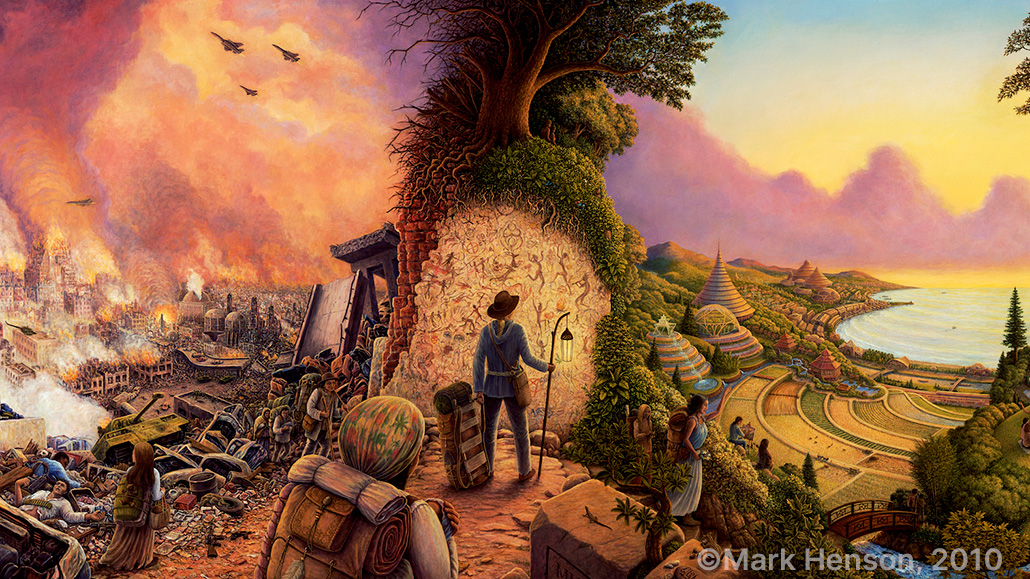
When the world feels chaotic, it can be difficult to know where we are, much less how to respond. That was the starting point for Meeting This Moment, an open conversation hosted by Great Transition Stories on September 15 as part of 11 Days to Prove Peace Is Possible, an international peacebuilding initiative led by Jon Ramer.
Jon opened the gathering by acknowledging the unfamiliar terrain we are navigating. “We’re discovering,” he said. “We’re in a new situation unlike anything we’ve ever been in.” We began with the moment people were actually living in. Where were we feeling stretched or disoriented? What was helping us find our bearings? How might we respond with greater awareness, capacity, and choice?
Finding Our Bearings
I began with a story from Spokane, Washington, where both I and NewStories founder Bob Stilger live. Bob has spent 25 years accompanying communities around the world after disaster, helping people consider what it means to rebuild after what they knew has been disrupted or destroyed. When devastating wildfires swept through the Spokane region several weeks ago, the disaster was suddenly happening at home.
For all his experience, Bob found himself asking some of the same immediate questions many of us were asking: What do we do? How do we show up for our community? There was something instructive in watching someone deeply experienced in disaster response become a person living inside the disaster. Knowledge did not remove the physiological experience of rupture or the need to first find his bearings.
At Great Transition Stories, the patterns of profound change help us ask: What story am I in? Where am I within it? What might this pattern help me see? As I shared during the gathering, “We have to stabilize ourselves if we’re going to be true stewards of the moment, in our families and our communities and around the world.”
Making Room for Grief
GTS founder Lynnaea Lumbard was living inside a transition of her own. One of her closest friends had passed away only two days earlier, and after years of studying and teaching stories of profound change, she was living one of humanity’s oldest transition stories herself. “Dying is also a transition story,” she said.
Lynnaea spoke about grief arriving in waves—loss alongside laughter, love, and gratitude—and about trying to find peace amid personal death and the enormous losses unfolding around the world. “How do we go into action from our grief, from our fear,” she asked, “holding a flag of possibility?” The old stories of initiation, birth, death, transformation, and renewal remind us that profound change often includes a period when what was known has fallen away and what comes next cannot yet be seen.
Looking for What Else Is Happening
GTS web architect and researcher Michele Stern shared one of the practices helping her meet this time: appreciation. “Just to go outside and look at a beautiful bird or just to be with people that I love,” she said. Michele carried that same attention into her research on peacebuilding efforts in places most often presented to the rest of us through stories of war and devastation.
She found people gathering, women forming networks across conflict lines, communities organizing care, and relationships built before crisis helping people respond within it. “They’re there if you look,” Michele said. The destruction is there. So are the people reaching toward one another.
Beginning Where We Are
GTS team member Markabadi brought the conversation inward, asking, “How can we ask of ourselves the things that we’re waiting for to change outside of ourselves?” He spoke about taking responsibility for our own center and paying attention to the stories we carry into ordinary encounters with spouses, friends, neighbors, and strangers.
As the conversation widened, people in the gathering added their own experiences. Juliet, who had spent many years working with people and communities around the world, described finding herself unexpectedly drawn toward working with nature. She had not planned the shift and was sometimes confused by it, but over time came to understand it as her particular contribution in this moment. “Everybody has their own unique offering,” she said. Listening, she had discovered, was part of finding hers.
Later, Joan spoke about creating conditions where different offerings can meet. “How can we create the conditions?” she asked. She imagined circles in which people bring their distinctive gifts and something emerges among them that none could have imagined alone.
Elizabeth Theriault carried the image further. She described the drum circles she facilitates, where people make sound together and then enter silence, still communicating after they have oriented themselves “in the place of heart.” An artist who has long worked with the butterfly as an image of transformation, Elizabeth recognized her own language of change in the transition patterns Lynnaea had shared. Before she finished, she recited a poem that had been passed to her: “Don’t hesitate. It is the time for gathering. We are the agents of change. Stand in your power fully. Peace is now. It is ours to arrange.”
Participants in What Comes Next
Throughout the gathering, we kept returning to our place within change. “We are participants in our evolution,” Lynnaea said. “It’s not just happening to us. We are happening to evolution.”
We may not know exactly where this moment is taking us. How we live, relate, and respond is already part of the story.
Watch the conversation here.


