

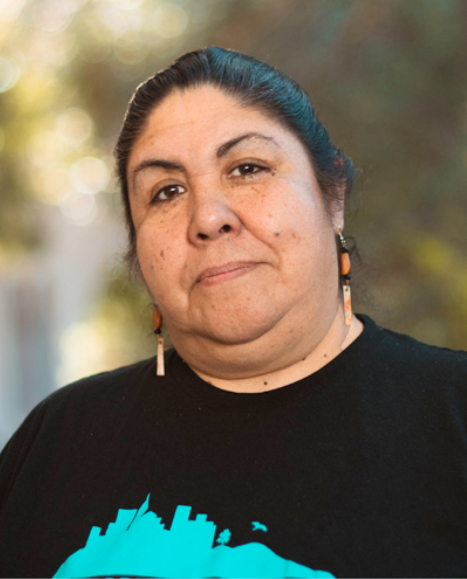
In April 2011, Corrina Gould joined Indigenous elders, organizers, and supporters at Sogorea Te’, an ancestral village and burial site in Vallejo, California. After 12 years of meetings, demonstrations, and appeals to protect the land from redevelopment, construction was about to begin. An elder lit a sacred fire, and a spiritual encampment began.
For 109 days and nights, people kept that fire burning. They brought food, supplies, songs, and prayers. Some visited for an afternoon; others stayed for weeks. The effort to protect a sacred place became an experience of living together in relationship with the land—and a source of possibility that would outlast the encampment itself.
For Corrina, that experience helped shape a question that continues to animate her work: how could Indigenous people regain places where their communities could gather, practice their cultures, and care for the lands that hold their histories?
Born and raised in Oakland, in the ancestral territory of Huchiun, Corrina has spent decades working to protect Ohlone sacred sites throughout the San Francisco Bay Area. She is a cofounder of Indian People Organizing for Change and serves as spokesperson for the Confederated Villages of Lisjan. Her organizing asks people to recognize Indigenous communities as living peoples with continuing relationships and responsibilities to the places now occupied by cities, businesses, and homes.
Much of that work has focused on shellmounds, places built over generations that served important community, ceremonial, and burial purposes. Development has leveled or covered many of them. For Corrina, their disappearance from the visible landscape does not end the obligation to protect what remains.
The struggle at Sogorea Te’ brought that responsibility into sharp focus. Although the encampment ended with an agreement intended to protect the site, subsequent construction damaged the land. The experience exposed the limits of protections that left Indigenous organizers without sufficient authority over the places they were trying to safeguard.
Corrina and fellow organizer Johnella LaRose began pursuing another approach. Rather than repeatedly responding when sacred places were threatened, they envisioned a network of land where Indigenous communities could restore relationships, grow food and medicine, hold ceremonies, and pass knowledge to younger generations.
In 2015, they founded Sogorea Te’ Land Trust, an urban Indigenous women-led organization working to return land to Indigenous stewardship.
The trust describes its work as rematriation: restoring Indigenous peoples’ relationships with ancestral lands while renewing the cultural practices and responsibilities those relationships sustain. Its vision connects land return with the everyday work of rebuilding community—planting, teaching, gathering, and preparing for the future.
An early opportunity emerged through Planting Justice, an East Oakland organization that offered space at its nursery. Land that had held discarded machinery and garbage became a place for food, medicinal plants, and a ceremonial arbor. In an interview with Bioneers, Corrina described the many hands involved in building that arbor and the feeling of encountering it in the middle of the city. A place imagined through years of organizing had become somewhere people could actually gather.
The trust also developed the Shuumi Land Tax, a voluntary contribution through which non-Indigenous residents and institutions can support its work. Shuumi means “gift” in Chochenyo. Despite its name, it is not a government-imposed tax; contributions support Sogorea Te’ Land Trust’s land return, cultural revitalization, and related programs. The invitation gives people a concrete way to connect acknowledgment of Indigenous history with an ongoing material commitment.
In 2024, years of organizing helped secure the transfer of a 2.2-acre property at the West Berkeley Shellmound site to the land trust. The collaboration involved the City of Berkeley, the Confederated Villages of Lisjan, the trust, and a broad community of supporters. Land long covered by a parking lot became the focus of plans for restoration, ceremony, and cultural renewal.
This work also unfolds amid disagreements among Ohlone leaders and organizations. Muwekma Ohlone and Ohlone Indian Tribe leaders have challenged aspects of the trust’s representation and the distribution of Shuumi’s benefits. Corrina has described her responsibility as being to her own tribal community. These disagreements are part of the context in which the trust operates; its work should not be understood as representing every Ohlone community.
Corrina’s organizing is featured in the documentary Beyond Recognition, directed by Michelle Grace Steinberg. Following efforts to protect sacred land and develop a women-led land trust, the film invites viewers to reconsider familiar urban landscapes and the histories and relationships they conceal.
Across these efforts, Corrina brings attention to the relationship between remembering and making change. Protecting a burial place, planting medicine, or creating somewhere for children to learn is also a way of shaping what can continue. Her work gives that responsibility a physical home: land where people can practice the future they hope to leave behind.
Why their voice matters: Corrina brings a grounded perspective on repairing relationships among people, place, and future generations. Her work connects historical harm with practical choices about land, resources, and responsibility today. Through sustained organizing and the creation of spaces for cultural renewal, she shows how a community’s vision can take material form. Her story invites us to look more closely at where we live, whose histories remain present there, and what meaningful participation in repair might require.


