

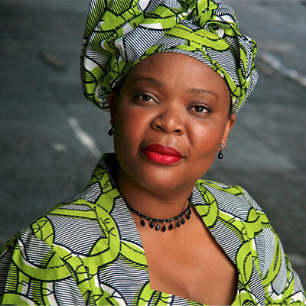
Leymah Gbowee knows what can happen when ordinary people decide that the future of their country is too important to leave in the hands of those waging war. In Liberia, she helped turn the grief, anger, and determination of thousands of women into a nonviolent movement that changed the course of a nation.
Born in Liberia in 1972, Leymah was 17 when civil war erupted, shattering her plans to attend university and become a doctor. Over the following years, she experienced the violence, displacement, hunger, and uncertainty that consumed her country. As a young mother, she struggled to protect and provide for her children while watching families and communities unravel around her.
She eventually trained as a social worker and trauma counselor, working with former child soldiers whose lives had been shaped by violence. That experience deepened her understanding of war’s lasting wounds—and of the need for healing that reached beyond the end of armed conflict.
By 2002, Liberia had endured years of devastating warfare. Leymah came to believe that women, who were carrying so much of the conflict’s suffering, could also become a powerful force for ending it.
Drawing on her Christian faith, she began organizing women to pray and advocate for peace. She soon joined forces with Muslim women, helping build an interfaith coalition that became the Women of Liberia Mass Action for Peace.
The movement brought together market women, mothers, displaced women, and community leaders across religious, ethnic, and economic divisions. Dressed in white, they gathered publicly, prayed, sang, protested, and demanded an end to the fighting.
They sat for hours in the heat and rain. They confronted political leaders and armed factions. They refused to accept that their only role was to endure the violence.
Their organizing helped pressure President Charles Taylor and rebel leaders toward peace negotiations. In 2003, as talks unfolded in Accra, Ghana, Gbowee and fellow activists continued demanding an agreement, helping sustain the pressure that contributed to ending Liberia’s second civil war.
The women did not accomplish this alone, and Liberia’s path toward peace remained difficult. But their movement demonstrated something extraordinary: people who had been excluded from formal political power could organize across entrenched divisions and help transform a national crisis.
Their story is told in the award-winning 2008 documentary Pray the Devil Back to Hell and Leymah’s 2011 memoir, Mighty Be Our Powers: How Sisterhood, Prayer, and Sex Changed a Nation at War.
The memoir is particularly revealing because Leymah does not tell the story from a distance. She writes about motherhood, exhaustion, grief, faith, personal struggles, and the difficult work of finding her own strength amid circumstances that repeatedly threatened to overwhelm her.
Her account offers a deeply human understanding of transformation. Courage is not presented as the absence of fear or suffering, but as something people discover and practice together, often before they feel ready.
In 2011, Leymah shared the Nobel Peace Prize with Liberian President Ellen Johnson Sirleaf and Yemeni democracy advocate Tawakkol Karman. The award recognized their nonviolent work for women’s safety and participation in peacebuilding.
For Leymah, however, peace has never meant simply stopping the fighting. It also requires addressing the social conditions, inequalities, and everyday forms of violence that prevent people from living with dignity and participating fully in their communities.
She went on to co-found the Women Peace and Security Network–Africa, supporting women’s leadership in conflict prevention, peacebuilding, and governance. In 2012, she established the Gbowee Peace Foundation Africa, which invests in education, leadership development, and community empowerment, particularly for women and young people in Liberia and West Africa.
Its work reflects a commitment to nurturing the next generation of peacebuilders rather than depending on exceptional individuals to carry movements forward.
Leymah also serves as executive director of the Institute on Gender, Law, and Transformative Peace at the City University of New York School of Law, bringing her experience in grassroots organizing into wider conversations about justice, reconciliation, and the conditions necessary for lasting peace.
Throughout her work, she returns to a lesson learned through lived experience: sustainable change requires people to recognize their shared humanity, organize around what matters, and discover the power they already possess when they act together.
Why their voice matters: Leymah offers a remarkable example of collective transformation made real. Her work shows how people living through profound crisis can move beyond division and despair to become active participants in shaping a different future. By bringing Christian and Muslim women together across social and economic lines, she helped demonstrate that peace is not simply negotiated by those in power; it can be demanded, practiced, and built from the ground up. Her story reminds us that courage is often collective, that healing and justice are inseparable from lasting change, and that ordinary people can accomplish extraordinary things when they discover what becomes possible together.


