

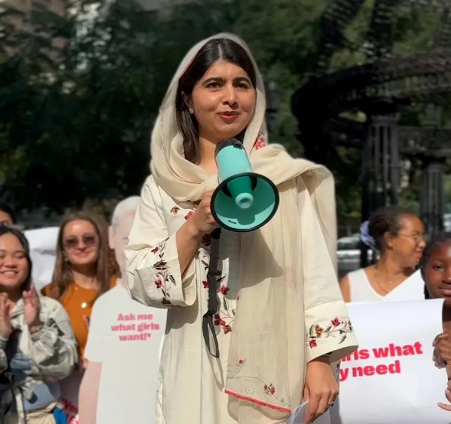
Malala Yousafzai believes every girl deserves the chance to learn, speak for herself, and shape her own future. What began as one young girl’s determination to stay in school has become a global movement challenging the systems that deny millions of girls that same opportunity.
Born in 1997 in Pakistan’s Swat Valley, Malala grew up in a family where education was both a daily practice and a deeply held conviction. Her father, Ziauddin Yousafzai, was a teacher, school founder, and advocate for girls’ education who encouraged his daughter to question injustice and speak her mind.
When the Pakistani Taliban took control of Swat and began closing girls’ schools, Malala was just 11 years old. Under the pseudonym Gul Makai, she began writing for BBC Urdu about life under Taliban rule. Her accounts brought readers inside an experience often described through political conflict and violence, but rarely through the eyes of a schoolgirl who simply wanted to continue learning.
She soon began speaking publicly about girls’ right to education, despite growing threats against her and her family.
On October 9, 2012, when Malala was 15, a Taliban gunman shot her as she traveled home from school. Two other girls were also wounded. Malala survived, underwent extensive treatment in the United Kingdom, and continued her advocacy.
The following year, she addressed the United Nations on her 16th birthday, calling for education for every child. In 2014, she shared the Nobel Peace Prize with Indian children’s rights advocate Kailash Satyarthi, becoming the youngest Nobel laureate in history.
But Malala’s work has never been simply about her own courage. It is about what becomes possible when girls everywhere have the freedom, resources, and support to exercise their own.
In 2013, she and her father co-founded Malala Fund, an international organization working to ensure every girl can complete 12 years of education. Rather than relying solely on global awareness campaigns, the organization invests in local advocates and civil society groups challenging the policies, practices, and economic barriers that keep girls out of school.
Its work spans countries including Afghanistan, Brazil, Ethiopia, Nigeria, Pakistan, and Tanzania. Through advocacy, grantmaking, and partnerships, Malala Fund supports efforts to strengthen education rights, increase public investment in schools, and help girls continue learning amid conflict, displacement, and discrimination.
Central to this approach is a belief that girls themselves must help define the solutions. Through its support for young women leaders and its efforts to bring girls’ experiences into education policy, Malala Fund seeks to move beyond speaking on behalf of girls toward creating opportunities for them to be heard and to lead.
That distinction matters. Malala understands education not simply as access to classrooms, but as a foundation for agency: the ability to make choices, challenge inherited limitations, participate in community life, and imagine a future different from the one prescribed.
Her advocacy also connects education to the larger challenges facing humanity. Poverty, war, gender inequality, forced displacement, and climate change all shape whether girls can remain in school. In turn, education strengthens communities’ capacities to respond to these challenges and create more equitable futures.
Malala has continued telling stories as another way of expanding whose experiences the world recognizes. Her 2013 memoir, I Am Malala, recounts her childhood and the events that brought her into international public life. In We Are Displaced (2019), she shares stories of girls and young women whose lives have been uprooted by conflict and persecution, bringing individual humanity to experiences too often reduced to statistics.
Her 2025 memoir, Finding My Way, explores a more personal dimension of her journey: growing into adulthood while navigating the expectations attached to becoming a global symbol. It offers a reminder that even those celebrated for extraordinary courage are still people discovering who they are and how they want to live.
A graduate of Oxford University, where she studied Philosophy, Politics, and Economics, Malala continues to advocate for girls whose educational opportunities remain threatened, particularly in Afghanistan, where Taliban restrictions have excluded girls from secondary education.
Through Malala Fund and her own storytelling, she keeps returning to a conviction that has guided her since childhood: the future should not be decided for girls without their participation.
Why their voice matters: Malala brings a powerful understanding of education as a pathway to freedom, participation, and systemic change. Her story reveals both the human cost of denying people agency and the possibilities that emerge when they claim it. Yet perhaps her most important contribution is the movement beyond her own remarkable experience toward supporting girls and young women as leaders in their communities. Her work reminds us that a more just and regenerative future cannot be created solely by those who already hold power. It must also be shaped by the voices, knowledge, and aspirations of those too often excluded from deciding what comes next.


