

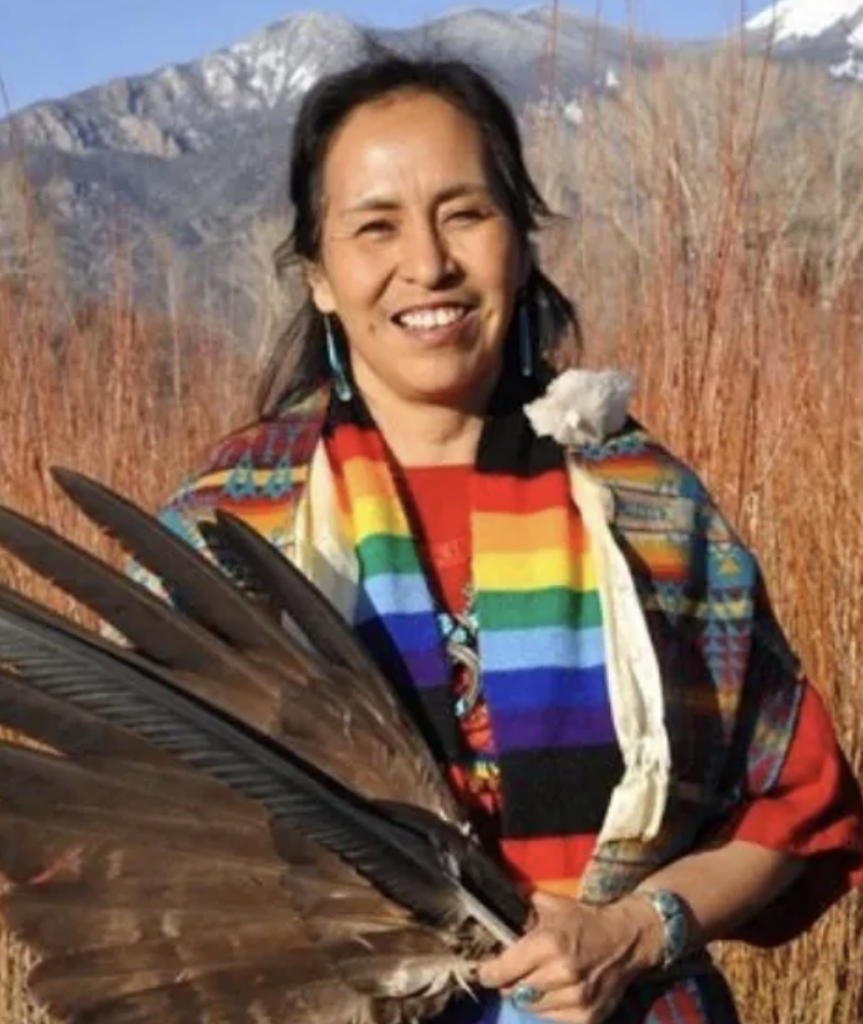
Pat McCabe asks what it would mean for a human life to help other life thrive. The question runs through her work as a ceremonial leader, artist, teacher, and speaker, inviting people to reconsider their place within a living world—and the responsibilities that come with belonging to it.
Known as Weyakpa Najin Win, Woman Stands Shining, Pat is a Diné mother and grandmother whose spiritual life has also been shaped by the Lakota tradition. Her work draws on these distinct cultural relationships to explore how people might live with greater care for one another, the Earth, and generations still to come.
That understanding emerged through a personal journey of reconnection. Her parents experienced the government boarding school system, and she grew up with a strong emphasis on Western academic learning. As a young adult, she began reclaiming her Indigenous identity with the guidance of elders in the Lakota tradition. Learning to trust ceremonial and spiritual ways of knowing required her to reconsider assumptions about knowledge itself: where it comes from, how it is recognized, and what it asks of us.
Pat has described this learning as difficult and deeply personal. During a period of loss, she continued participating in ceremony while finding that familiar ways of understanding and directing her life were no longer sufficient. She gradually learned to release the expectation that she needed to know the answer before she could move forward.
That experience informs her teaching about uncertainty. She encourages people to remain receptive when they reach the limits of what they know, allowing room for guidance and understanding that their existing frameworks may not yet accommodate. In her account, listening to spirit is a practice developed through experience, humility, and attention.
At the center of Pat’s work is what she calls the Indigenous sciences of Thriving Life. She brings this inquiry into conversations about sustainability, asking people to consider the relationships that allow life to flourish and the human behaviors that support or disrupt them.
She often speaks of the Sacred Hoop of Life, describing a place for every living being and a contribution each makes to the whole. Humanity, in this understanding, also has a place and a responsibility. The task is to discover how to fulfill it.
This perspective changes the questions people bring to ecological crises. Decisions about how we live involve our relationships with water, land, plants, animals, and one another. Pat asks people to become more attentive to those relationships and to the consequences of acting as though human life could flourish independently of them.
Her teaching uses the term “InterBeing” to describe this connected existence. Through talks and programs, she explores how people can experience themselves as part of nature, recognize forms of knowing beyond intellectual analysis, and practice greater accountability in families, communities, and working relationships.
Another central strand of her work concerns reconciliation between the masculine and feminine, which she speaks of through Women’s Nation and Men’s Nation. She is interested in how both can contribute to thriving life, and in renewing a sense of the sacred masculine.
Her approach creates room to examine harm while imagining other ways of relating. She invites people to consider how inherited expectations about power, identity, and responsibility shape their relationships—and how those expectations might change. Her work on the feminine and masculine belongs within her larger inquiry into how human beings can participate well in the community of life.
Pat brings these questions into international gatherings, teaching settings, and conversations across cultures. She has participated in Indigenous gatherings around the world, served as a cultural consultant and advisor to Pachamama Alliance, and contributed to Bioneers conversations about women’s leadership and relational intelligence. Across these settings, she shares teachings rooted in her own experience and cultural relationships.
Art is another expression of that work. Her paintings are created with the intention of supporting personal, Earth, and global healing. Alongside ceremony, writing, and public speaking, they offer another way to engage the relationships and possibilities she explores. Her website brings these dimensions of her work together under the words “For Thriving Life, Light and Love.”
Through all of these forms, Pat returns to the possibility that people can learn to live differently. Her work asks us to examine what we have accepted as inevitable, become more attentive to the life around us, and consider what our presence makes possible for others.
Why their voice matters: Pat brings a perspective on transformation rooted in belonging, reciprocity, and responsibility to life. Her teachings invite us to examine the assumptions beneath our decisions, including how we understand knowledge, exercise power, and relate to the living world. By connecting personal experience, cultural teachings, and ecological responsibility, she opens space to imagine human lives that contribute to the flourishing of others. Her voice offers a searching, hopeful question for uncertain times: how might we become a beneficial presence in the world we share?


