
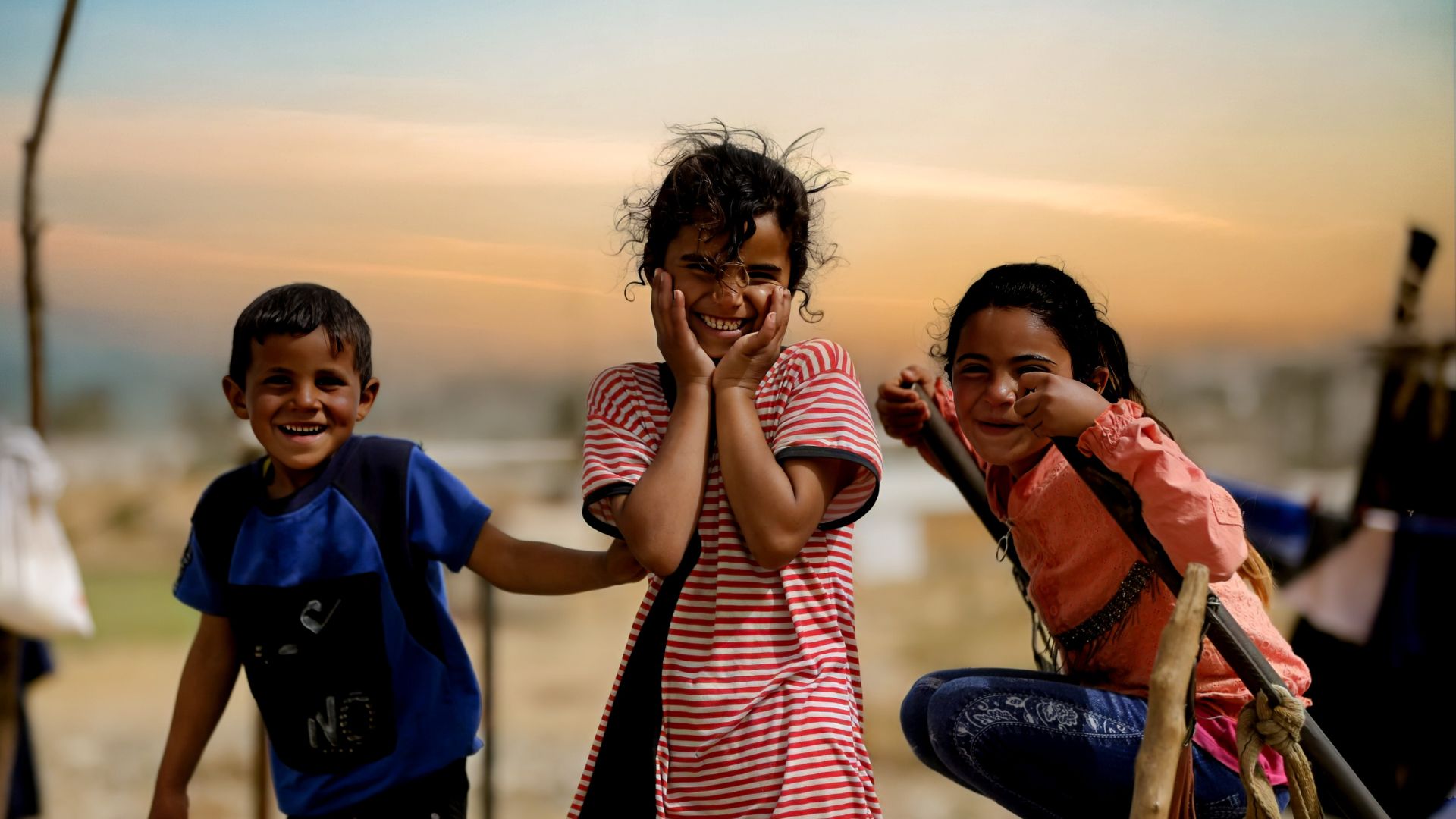
The images I have seen coming out of Gaza have been horrifying to me. So when, in a conversation between the Great Transition Stories team and Jon Ramer about his 11 Days for Peace initiative, he mentioned the Gaza Children’s Village, it caught my ear. If something healing has taken root in the midst of so much devastation, I want to know what it is. And I want to know what else is happening in other conflict zones.
I am blown away by how much is emerging in places dominated by war. Everywhere I looked I found heartwarming stories of cooperation, care and relationship-building, frequently across the divides of conflict, and frequently initiated by groups of women.
Here is a small sample of what I have learned…
Building Together Across a Line War Insists Is Uncrossable
The Gaza Children’s Village, (now a part of One Village with the Parents Circle Families Forum) is a network of schools for Gaza’s orphaned and displaced children. The organization operates inside Gaza and now serves more than 21,000 children a day with education, meals, healthcare, and trauma-informed support.
It began after Dr. David Hasan, a Palestinian-American neurosurgeon whose parents are from the West Bank, joined a medical mission to Gaza in December 2023. He has described being deeply affected by the death of a young child whose entire family had been killed. When he returned to North Carolina, he knew he wanted to find a way to help.
On a second trip to Gaza in 2024, Hasan became increasingly aware of the scale of the orphan crisis and began imagining a village that could care for thousands of children. After an interview in the Israeli newspaper Haaretz in May 2024, he received what he described as “an overwhelming response from the people in Israel.”
The first Academy of Hope opened in southern Gaza in July 2025. Hasan recalled, “We expected 200 kids. Five hundred arrived.” World Central Kitchen began providing meals the very next day, an example of how quickly one effort could connect with another and become something larger.
By October 2025, more than a thousand Israelis had contributed to the project, and that support has continued to grow. Just this month, GCV opened a medical clinic in partnership with NATAN, an Israeli humanitarian organization.
Today there are 14 Academies of Hope across central and southern Gaza, supported by more than 400 local educators, healthcare workers, counselors, and administrators.
When compared to the millions of people who are still displaced in Gaza, this might not seem like much, but that a network of schools and clinics can be built by Palestinians and Israelis working together—and so far, not attacked by the Israeli military—is a ray of hope in this land with so much devastation.
Peace Taking Root in Ordinary Life
In Sudan, I found a story that moved me for a completely different reason.
In Kassala, in eastern Sudan, 25 women have created a shared trading business. Some were displaced by the war from Kadugli in South Kordofan; others are members of the local community. They came together across social and tribal divisions to sell everyday necessities and build an income together.
One of the women, Gisma, described what the experience had changed for her:
“I used to worry about the future, about division,” says Gisma, from Kassala. “But this project gave me hope. We now have a reason to work together, to support each other. It has changed how we see ourselves—not just as tribes, but as women with a common purpose.”
The business matters, of course. These women need livelihoods in the middle of a terrible war. But something else is happening too. Their sense of who they are in relation to one another is changing. They are not simply cooperating across a divide. They are beginning to see themselves as part of something larger than just their little trading business.
And they are not alone. In Kassala, elders are mediating disputes through a Peace and Reconciliation Group, and young people are being trained as peace ambassadors. Elsewhere in Sudan, community networks have emerged to distribute food and medicine, operate community kitchens and keep essential services going where formal institutions have collapsed.
These pockets of peace in these war torn areas is not coming from official declarations, but instead, it comes in the form of women–who may have once regarded as strangers–running a business together, elders settling disagreements, and neighbors organizing food for their communities.
From Listening to Women’s Perspectives to a Voice for Peace.
When I turned my attention to what was happening in Ukraine, I discovered what can happen when a small network of women is given time to grow.
The Women’s Network for Dialogue and Enduring Peace began in 2015, about a year after Russia annexed Crimea and war broke out in eastern Ukraine. Nina Potarska, one of the founders of the network, was curious about how women adapt and survive in times of crisis so she began meeting women’s organizations on both sides of the front line.
They stayed in touch. “We realized we all had a lot in common,” Potarska says. Eventually they began meeting more regularly and building a network of women involved in humanitarian work and leadership in their communities.
This was not an easy bridge to build. “The biggest challenge was that we represented two sides of the front line,” Potarska recalls. “It was our family members who were at war with each other. It was our men who were shooting at each other.” Yet the women came to a shared realization: none of them wanted the conflict. They had to find a way, she says, “to overcome our differences, to overcome our egos, to overcome our fears.”
When Russia launched its full-scale invasion in 2022, the network they had already built became even more important. Members helped evacuate tens of thousands of civilians, resettle more than half a million displaced people, provide humanitarian and psychological support, help return children from Russia, and continue the slower work of dialogue and reconciliation.
And they are still at it. More recently, this network of women meeting with diplomats and policymakers who are involved in discussions about an eventual ceasefire, and putting forward detailed recommendations based on more than a decade of work with communities affected by the war. They argue that the people who have lived through the conflict need to help shape what comes next. Potarska puts it simply: “We all suffer. Perhaps in different ways, but we need to put an end to it.”
A Single Note, Not Yet a Chord
In Iran, a network is forming too—not across the war’s front line, but across deep political and social divides.
I almost skipped Iran, thinking it might be too early for a story like this. I was wrong. In July, 268 Iranian public figures inside Iran—including conservatives, reformists, independent intellectuals, economists, physicians, teachers, lawyers, environmental activists, Sunni religious leaders, former parliamentarians, and former senior government officials—came together to issue a declaration titled “We Do Not Want War.”
“Despite all our differences,” they wrote, “we raise the call of ‘No to War.’”
The declaration closes with words from a 13th-century Persian poet:
Even if you possess the strength of an elephant or the claws of a lion,
To me, peace is still better than war.
—Saadi
This isn’t a network yet, not the way Gaza’s interconnected organizations or Ukraine’s women’s network are. It is closer to a single shared note being struck by people who otherwise stand very far apart. But that, too, is how a network can begin.
Beneath the Headlines
The news tends to show us the suffering and destruction of war, and of course that is real. But what I have learned through this is that something very different is happening at the same time.
Maybe in spite of war—and sometimes because of it—networks are being created that strengthen bonds within and between communities. Frequently, women are at the center of them. People are finding ways to work together, care for one another, and keep relationships alive across conflict lines.
And in doing that, they reveal something war can make very hard to see: how much people on opposite sides of a conflict actually have in common.
And that gives me hope.


