
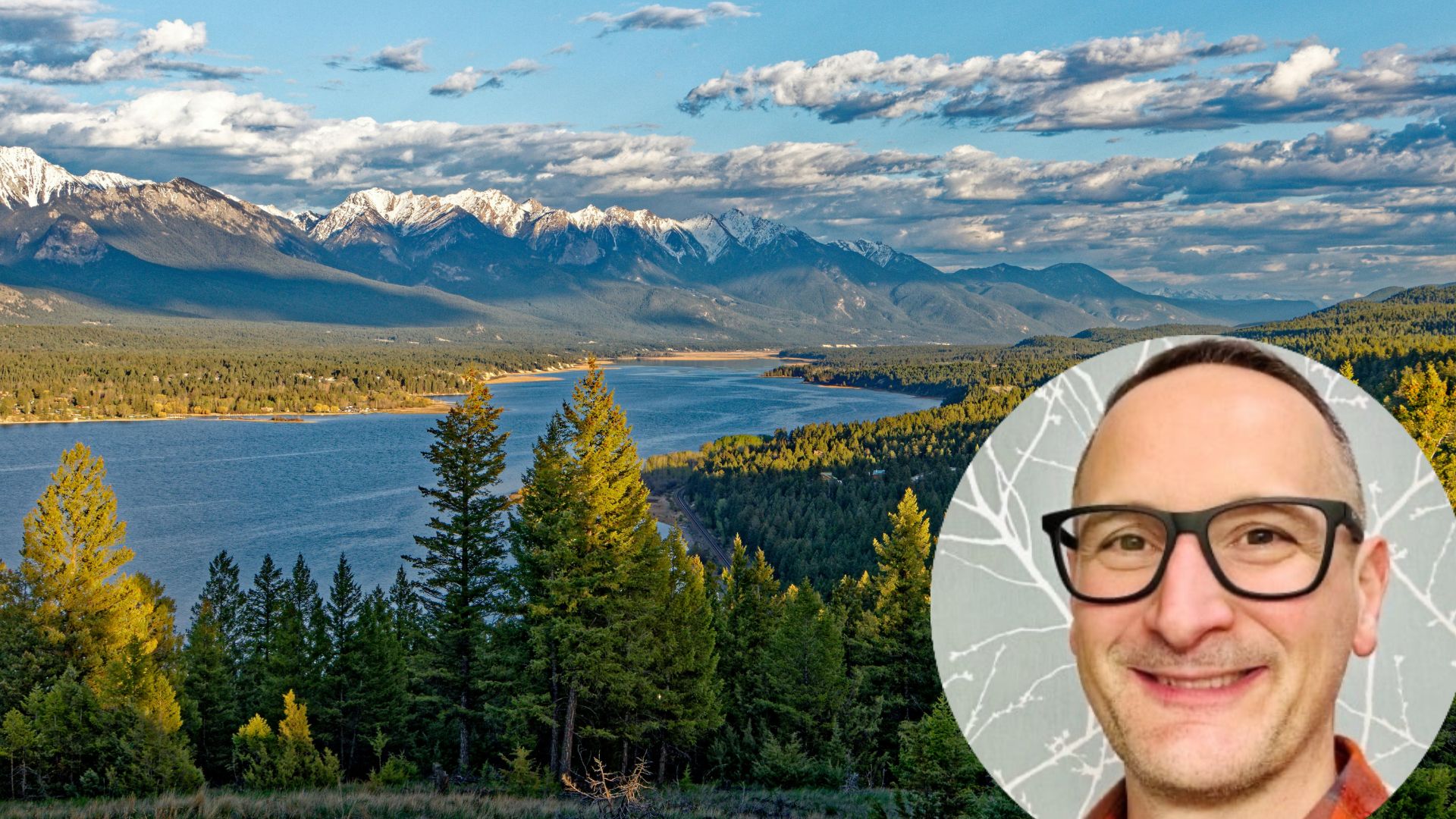
Photo: Breathtaking Mountain and Lake View in British Columbia
When a 120-foot tree came crashing down behind Dan Séguin’s home in the mountains of British Columbia, it narrowly missed the house. The sound was unmistakable, and so was the response. Before Dan could even get outside, three neighbors had arrived with chainsaws.
“Because they heard it, they came out, and they chopped it up,” Dan says. “That’s crazy cool.”
It’s a familiar expression of life in Queens Bay, a small community along Kootenay Lake in Canada. Neighbors don’t necessarily gather for dinner or socialize regularly, but they know how to find one another when something needs doing. When the community’s lake pump needs attention, people come together to fix it. When a tree falls, someone brings a chainsaw. “I do the same,” Dan says.
For Dan, who now oversees fire and emergency management services across an expansive rural region, these everyday expressions of care are at the heart of what it means to be prepared. And they represent something he didn’t always know he needed.
Finding His Way Into Community
Dan grew up in Ottawa and Montreal before moving to the Kootenays in 2011. For much of his life, he gave little thought to where his water came from, what happened when he flushed a toilet, or how electricity reached his home. “I was very disconnected from my world,” he says.
Moving to a remote home along Kootenay Lake changed that. Suddenly, water, electricity, weather, and access to emergency services were immediate concerns. A power outage could last five or six days. The nearest hospital was an hour and a half away. And the people living nearby mattered in ways he hadn’t previously experienced.
At the time, Dan and his wife, Alicia, had spent years running an organizational development consulting firm. He understood organizations, systems, and the relationships that help people work together. But he wanted to feel more connected to the community where they had chosen to live. “So I ended up joining the volunteer fire department,” he says, remembering his thinking at the time: “Oh, okay, I guess I’ll try that out as a way of connecting to community and getting to know people.”
That was in 2013. What began as a way to meet people became a turning point in his life.
Inside the fire hall, Dan found himself alongside farmers, mechanics, and neighbors whose lives and experiences were different from his own. Some had spent their lives working the land. Others brought practical knowledge he had never needed to acquire. “It brings this amazing mix of people from different backgrounds, but they are all there to serve,” he says.
They answered calls in the middle of the night, entering strangers’ houses on what might be the worst day of those strangers’ lives. “It is a sacrifice to be a volunteer firefighter,” Dan says. “You miss Christmas, you miss the family dinners.” And still, they answer the call.
The experience also changed the direction of his career.
Learning to See What Was Changing
Over the years, Dan began noticing changes in the landscape around him. Wildfires had always been part of life in British Columbia, but the seasons were becoming more intense and less predictable. Fires were behaving differently, and familiar weather patterns were becoming harder to anticipate.
As a firefighter, Dan learned to watch the sky with new attention, following cold fronts, thunderstorms, and shifting weather systems. “In summer, I watch weather differently,” he explains. During the severe 2024 wildfire season, he remembers standing along the lakeshore watching clouds approach. “Tomorrow’s going to be a weird day,” he thought. Afterward, he spent approximately seven weeks working full-time in the Emergency Operations Center, sometimes for 10 to 18 hours a day.
His growing concern about climate change led him toward a new professional path. In 2019, he reached a decision: “I can’t not work in climate change.” He wasn’t a climate scientist, but he had years of experience in organizational development, community engagement, and firefighting. Emergency management offered a way to bring those experiences together.
He pursued graduate studies, worked on federal disaster assistance policy, and eventually joined the Regional District of Central Kootenay. Today, as acting general manager of Fire and Emergency Management Services and acting regional fire chief, Dan helps oversee 20 fire departments and approximately 350 volunteer responders across a mountainous region roughly the size of Belgium, home to about 60,000 people.
It’s an enormous area to protect, particularly when emergencies happen in several places at once. “We can’t be everywhere all at once,” he says. “It’s not possible.” He also knows that people have different capacities to prepare, different resources available to them, and different levels of trust in the institutions responsible for public safety. For him, these realities make relationships even more important.
Finding Common Ground
Dan has noticed something interesting about the way people respond to him. When he arrives as a firefighter, people are generally relieved to see him. When he arrives as a government emergency management official, the reception can be quite different. “People were like, yay!” he says of his firefighter role. In emergency management, the response can be more like, “Oh, you guys put new rules on us.”
Government representatives may be associated with regulations, restrictions, and decisions that people feel are being imposed upon them. In communities where independence is deeply valued, those tensions can run high. Dan has learned that trust cannot be demanded through a job title or established in the middle of an emergency. It has to be cultivated.
When he first joined the regional district, he inherited a contentious climate action planning process. “They had kicked a hornet’s nest and handed it to me,” he recalls. Community meetings had become difficult, with residents expressing frustration about both the proposed plan and the way it had been presented.
One man attended meeting after meeting, traveling considerable distances across the region to challenge what he was hearing. Dan kept showing up, too. Over approximately three months, the two continued encountering one another. They didn’t suddenly agree on everything. But something eventually shifted.
At one of the final meetings, The man told Dan that he had come to know him through their conversations. “You care,” he told Dan. “And that matters to me.”
Dan remembers responding with a little humor: “Hey, are we becoming friends?”
Later, the man defended Dan during another public meeting, acknowledging their disagreements while affirming his respect for Dan as a person.
These days, he spends less energy trying to persuade people to adopt a particular position on climate change and more time looking for concerns they can share. “How do we find that common ground that we can both stand on?” he asks.
He might begin by asking residents what they’re noticing in their own surroundings. Are there more smoky days? Is a well running dry earlier in the summer? Are local forests changing? “Can we agree that what we want is a positive future for your kids and their kids and their kids, which means clean water, clean air, good soil to grow food? That’s where I bring people together,” he says. “That’s where I try to meet people.”
Finding common ground doesn’t resolve every disagreement, but it creates room for people to work together.
Dan recalls calling a neighboring fire chief at one in the morning during a structure fire. There had been difficulties with mutual aid, and he needed to speak with her directly. She answered. “That’s what relationship does,” he says. “That’s a game changer. That is social capital.” He describes it as having invested enough in a relationship that, when a difficult moment arrives, someone recognizes the person calling and is willing to pick up the phone.
A Red Binder and 38 Households
When Dan purchased his home in Queens Bay, something unusual came with it. A red binder.
“My house came with a red binder,” he says, still sounding delighted by the discovery. Inside were the names and phone numbers of people living in the community’s 38 households, along with information about the resources they had and the ways they could help one another. “We were all divided into little pods with a leader, and we coordinate and work together.” Dan remembers his reaction to the binder: “What? This is incredible.”
The binder reflected a community that had already considered what might happen if a wildfire threatened their homes, the power went out, or someone needed assistance. Dan eventually joined the community association’s board and helped maintain those connections.
“It’s not the day that the tree falls behind your house that you need that neighbor to be like, hi, can you come and help me,” Dan says.
Dan recognizes that neighbors don’t all have the same resources or abilities. Protecting a home against wildfire, for example, can require money that some households simply don’t have. People may have health challenges, mobility limitations, caregiving responsibilities, or other circumstances that make preparation more difficult. “Not everybody comes in equal,” he says.
Dan and Alicia have developed their own household emergency plans. Because his work may require him to spend extended periods at the Emergency Operations Center, they’ve discussed what Alicia will do if an emergency threatens their home. “We’ve got it all mapped out so that she’s not going to be stressed,” he says. But their preparations don’t end at their property line. They also think about the neighbors who may need additional support.
The Many Ways We Show Up
Dan describes himself as an introvert. “There’s a reason I live in the forest on the side of a cliff,” he says. Yet he makes a deliberate effort to know the people around him, including those whose views, backgrounds, and experiences differ from his own. Volunteering as a firefighter helped him discover something about those differences.
“As much as I can really loathe somebody’s political views, I’m shocked at times that they’re the first one who shows up when someone’s car’s crashed into the ditch,” he says. Then he corrects himself. “Or I used to be shocked by it. Now it doesn’t surprise me anymore.”
The fire department taught him how people who disagree about many things can still share a desire to help. He calls it “this weird common ground of the desire to run toward and to support one another and to give time.”
But he is quick to point out that not everyone needs to run toward an emergency. “Not everybody needs to be like that,” he says. “And that’s okay. There are so many different roles for us to hold in community.”
Some people become firefighters or emergency responders. Others bring a meal, share resources, help with a practical task, or offer comfort when someone is having a difficult day.
Dan also recognizes the importance of remaining steady enough to keep showing up. With so much uncertainty surrounding climate, disaster, and the future, he works to cultivate what he calls “relaxed attentiveness.”
“I don’t want to freak out about it because it freaks me out,” he says. Staying informed and aware without becoming consumed by anxiety takes practice, particularly for someone who responds to emergencies and carries responsibility for so many people. “I work hard to support and find in myself that relaxed attentiveness to be able to be in it and show up well.”
Resilience can look like a household emergency plan, a list of phone numbers, or a conversation with someone whose views differ from your own. It can mean knowing who might need help when the power goes out, or simply noticing that something has happened next door and going to see what you can do.
Alongside the scale of his professional responsibilities, Dan knows it’s integral to be part of the communities he serves. His go to introduction in meetings is often, “Hi! I’m Dan from Queens Bay,” he says.
He’s still the person who joined a volunteer fire department because he wanted to know his neighbors. And when a tree came crashing down behind his house, those neighbors were already on their way.
Connect with Dan on LinkedIn. For information on British Columbia’s work rising to the challenge of disaster and climate risk, visit ClimateReadyBC.
There are so many different roles for us to hold in community.


