
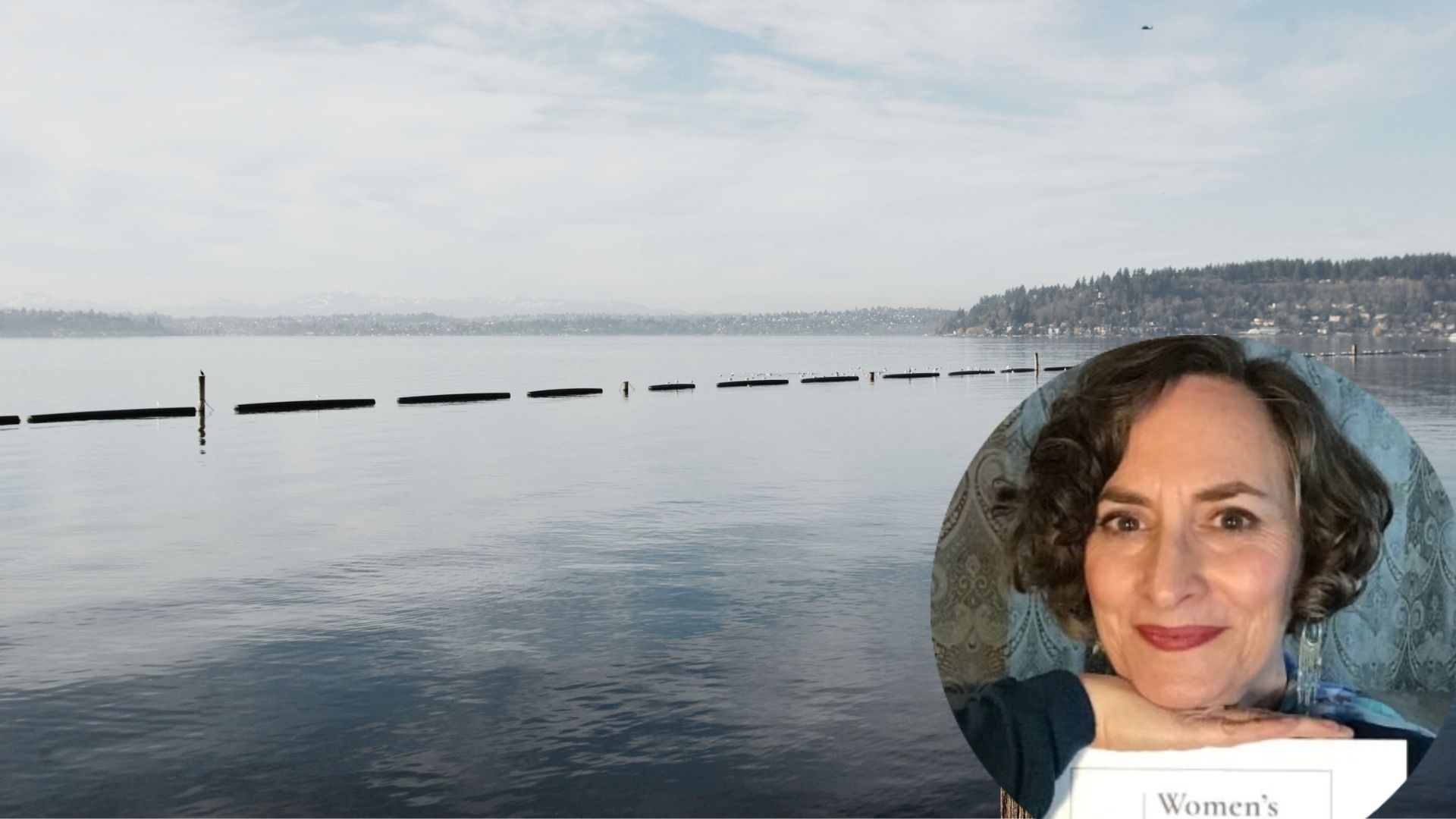
Photo: Lake Washington, Renton, Washington
During the pandemic, when people were keeping their distance and everyday interactions had become complicated, Deb Needham decided she was going to bake her way into getting to know her neighbors.
“I just started baking cookies, scones, rolls, muffins,” she recalls. Wearing a mask and taking precautions in her kitchen, she would prepare enough for a few households at a time, then make her way down the street. She’d ring a doorbell, step back, introduce herself, and offer something she’d made.
Her neighborhood had about 30 households, and nearly everyone welcomed her visits. One exception was Charles, who lived down the street. When Deb arrived with peanut butter cookies, he explained that he was allergic to peanuts. She asked what he liked instead.
A few days later, she returned with oatmeal raisin cookies.
For someone who describes herself as an introvert, going door to door wasn’t necessarily comfortable. But Deb had learned long before the pandemic what a difference knowing the people around you could make.
Learning What It Means to Get By
Deb grew up in a log cabin about 10 miles outside a small town. Money was scarce. Her father was unemployed for a time, and the family relied on government food assistance and the generosity of people he’d come to know.
One acquaintance at the grocery store helped the family obtain milk that would otherwise have been discarded. Another shared milk from his cows. Deb remembers that when the cows grazed on wild onions, the milk took on an unmistakable flavor.
“So you’re pouring onion milk on your cereal,” she says, laughing at the memory. “It was awful. But it was great for baked potatoes when we used the cream.”
Her father was resourceful and outgoing, someone who made connections wherever he went. He was also quick to help others. When the family encountered a stranded motorist on a snowy road, he’d stop and try to pull the vehicle free. If he couldn’t, he’d squeeze the stranger into the family’s already crowded pickup truck, bring them home, and give them one of the children’s beds for the night. The next morning, they would return to help retrieve the car.
“We just did that,” Deb recalls. “It was a way of life for us.”
“We probably wouldn’t have made it if not for community,” she says.
Finding Her Way Into Emergency Management
As a child, Deb noticed that whenever someone was hurt on the playground, the other children would come looking for her. She was the one who stayed calm and seemed to know what to do.
She imagined becoming a doctor, partly because she didn’t know many other professions that involved responding to emergencies. Watching the television show Emergency! introduced her to paramedics, but the men she saw on screen seemed much bigger and stronger than she was. At just over five feet tall, she assumed the work was beyond her reach.
Then, as a young adult attending an event at Portland’s Waterfront Park, she noticed a woman working with an ambulance crew.
“Wait a minute,” she remembers thinking. “Maybe I can do that too.”
Deb became a paramedic in the 1980s, later returning to college and finding a position in a 9-1-1 center, and then emergency management. Today, with approximately 28 years in the field, she has led responses to everything from floods and windstorms to hazardous-materials incidents, cybersecurity emergencies, and the pandemic. She was hired as the City of Renton’s first emergency manager and built its program from the ground up.
“There are things that we can do that make it better,” she says. “Even if the bad thing happens, there are things you could have done in advance to make it easier on you later.”
She saw that principle come alive in her own household when her daughter was nine years old. Deb had recently entered emergency management and brought home a Red Cross checklist of emergency supplies. Together, they began assembling what they would need, storing their supplies in a central room away from windows.
Her daughter loved checklists. Every time Deb returned from the grocery store, she wanted to know what had been purchased and what was still missing.
A few years later, Deb was driving to work when traffic came to a standstill. She couldn’t cross the bridge from Portland into Vancouver, Washington, and didn’t know what had happened. She called home and asked her daughter, then in middle school, to turn on the news.
A truck carrying hazardous materials was on fire near their home.
Deb’s first instinct was to turn around and go back. But that would have taken her toward the danger. Instead, she asked her daughter whether she remembered where their shelter-in-place supplies were kept.
“Yep, laundry room, top shelf,” her daughter replied.
She knew what to do if officials issued an alert. And when they learned that the truck was carrying oxygen, the immediate concern about a toxic release eased.
“That’s when I realized how much preparedness makes a difference in the human psyche,” she says.
The Missing Ingredient
For much of Deb’s career, emergency preparedness focused heavily on what individuals and households could do: make a plan, gather supplies, and learn how to respond. She still believes those steps are essential. But over the past decade, her understanding of preparedness has expanded.
“You can have a pretty good stockpile and you can be okay,” she says. “But what if your stash is the thing that’s wiped out in the flood? What if you are left with nothing?”
No household can anticipate every possibility or provide for every need. And people don’t begin with equal access to resources. Some can afford to assemble extensive emergency supplies, while others are working hard simply to meet their daily needs. Older adults, people with disabilities, and neighbors who face language barriers may encounter additional challenges when an emergency arrives.
“The ability to help each other is probably the most important part of being prepared,” she says.
In Renton, her work has included helping residents develop practical skills through the Community Emergency Response Team program, which trains volunteers to assist their neighborhoods when professional responders cannot immediately reach everyone. She has also worked to make emergency information more accessible and to encourage neighbors to recognize who might need help evacuating or understanding an alert.
Renton once trained dozens of facilitators for a program called Map Your Neighborhood, which encouraged residents to organize preparedness conversations on their own blocks. Only three followed through. When Deb asked an intern to investigate why, the answer was revealing.
People didn’t feel comfortable inviting neighbors to a meeting because they hadn’t met them.
Deb understood the hesitation. “As an introvert, I have a lot of stories in my head,” she says. “They probably just want to be left alone. They probably don’t care. They won’t even like me.”
She also knew that showing up at someone’s door to discuss emergency preparedness could feel uncomfortably close to selling something.
“I didn’t want to feel like I was a door-to-door evangelist, saying, ‘Hey, you want to come and learn more about preparedness?’ Because then they’re going to go, ‘Weirdo.’”
Baking gave her a way to begin.
“People don’t turn down baked goods,” she says.
What Happens When We Know One Another
The relationships Deb cultivated during the pandemic have become part of the everyday fabric of her neighborhood. Neighbors share resources, host gatherings, and notice when something seems wrong.
When an older woman across the street wasn’t seen for a while and her newspapers began piling up, someone noticed. A neighbor who had a key entered her home, discovered she needed help, and called 911. Other neighbors began asking whether her dog was being cared for and what else they could do.
And then there was Charles, the neighbor who preferred oatmeal raisin cookies.
About a year after Deb’s baking visits began, she heard something outside her home early one morning. Two men were near her car, and she soon discovered that they’d stolen its catalytic converter. She ran outside in her bathrobe but couldn’t identify their vehicle.
A couple of days later, Charles mentioned that he’d seen her outside at five in the morning. When he learned what had happened, he remembered a car speeding through the neighborhood. He hadn’t captured its license plate, but he’d once sold cars and could identify its make and model. He also remembered which street it had taken.
That information helped Deb identify a lead and report it to the police.
“So because I took cookies to Charles,” she says with amusement, “we busted a catalytic converter theft ring.”
“Building community is really the magic that makes emergency preparedness work,” she says.
When a man on Deb’s block lost his home to a fire, she went door to door asking neighbors whether they had unused gift cards they could contribute. She collected an envelope of them to help him through the months ahead.
The Courage to Act, and the Space to Grieve
Deb calls herself a crisis optimist. She’s witnessed devastating injuries, sudden losses, and the uncertainty that can overwhelm people when their lives change without warning.
“There are always options,” she says.
Moving forward often requires flexibility, difficult choices, and a willingness to let go of how we expected things to be. Disaster can change the very landscape people inhabit. Recovering and rebuilding may require imagining a future different from the one they’d planned.
“Optimism and flexibility are probably the two most important characteristics to get through those hard things,” she says.
Her years as a paramedic also taught her that when people are frightened or overwhelmed, having something concrete to do can help restore their ability to act. She remembers asking distraught family members to gather medication information or giving bystanders practical tasks at an accident scene. Providing a useful role helped people find some steadiness amid the confusion.
Yet she also understands that some experiences cannot be resolved through action alone.
Early in her career, Deb responded to an accident involving a 14-year-old boy who had been struck by a truck. His injuries were devastating, and he died the following day. Deb remembers the boy’s father riding in the ambulance, urging her to drive faster. She carried the weight of that experience home.
After her shift, she went to a small meditation space, lit a candle, and prayed for the boy and his family. She also consciously released responsibility for what she could not have changed, reminding herself that she did the best she could.
“We have to acknowledge the bad thing has happened, and we have to grieve it,” she says. “It’s not trying to sweep it under the rug and pretend nothing happened. It’s acknowledging its significance.”
For Deb, tending to our emotional lives is as important as attending to our physical needs. Sometimes that means gathering with others, taking a quiet moment to reflect on what has happened, or honoring and supporting those who were impacted. It can also mean recognizing when we’ve absorbed as much difficult news as we can reasonably carry.
She limits her own media consumption, seeking a balance between remaining informed and becoming overwhelmed. She asks herself whether something requires her attention, whether there is meaningful action she can take, and when she needs to step away.
The Resilience We Make Together
Deb has spent nearly three decades helping people prepare for circumstances she hopes they will never experience. She knows that no amount of preparation can anticipate everything, and there will be times when she needs help herself.
But she’s prepared what she can, and she knows the people around her.
“I have community to help me,” she says, “and I know I can figure it out from there.”
You can find Deb on LinkedIn to connect and follow her work.
Building community is really the magic that makes emergency preparedness work.


2 Responses
Loved your thoughts about community and emergency preparedness. I started an organization called LEAP in Seattle which included ground up like you described. Seattles concept is of course, hubs. I moved to Port Angeles in 2019 where we successfully use CRRT as a big part of Preparedness. Congratulations on what you’ve done in Renton.
Thank you for your note, John. I’ll pass it on to Deb, I know she will be grateful to hear your thoughts. Cheers to doing the good work.