
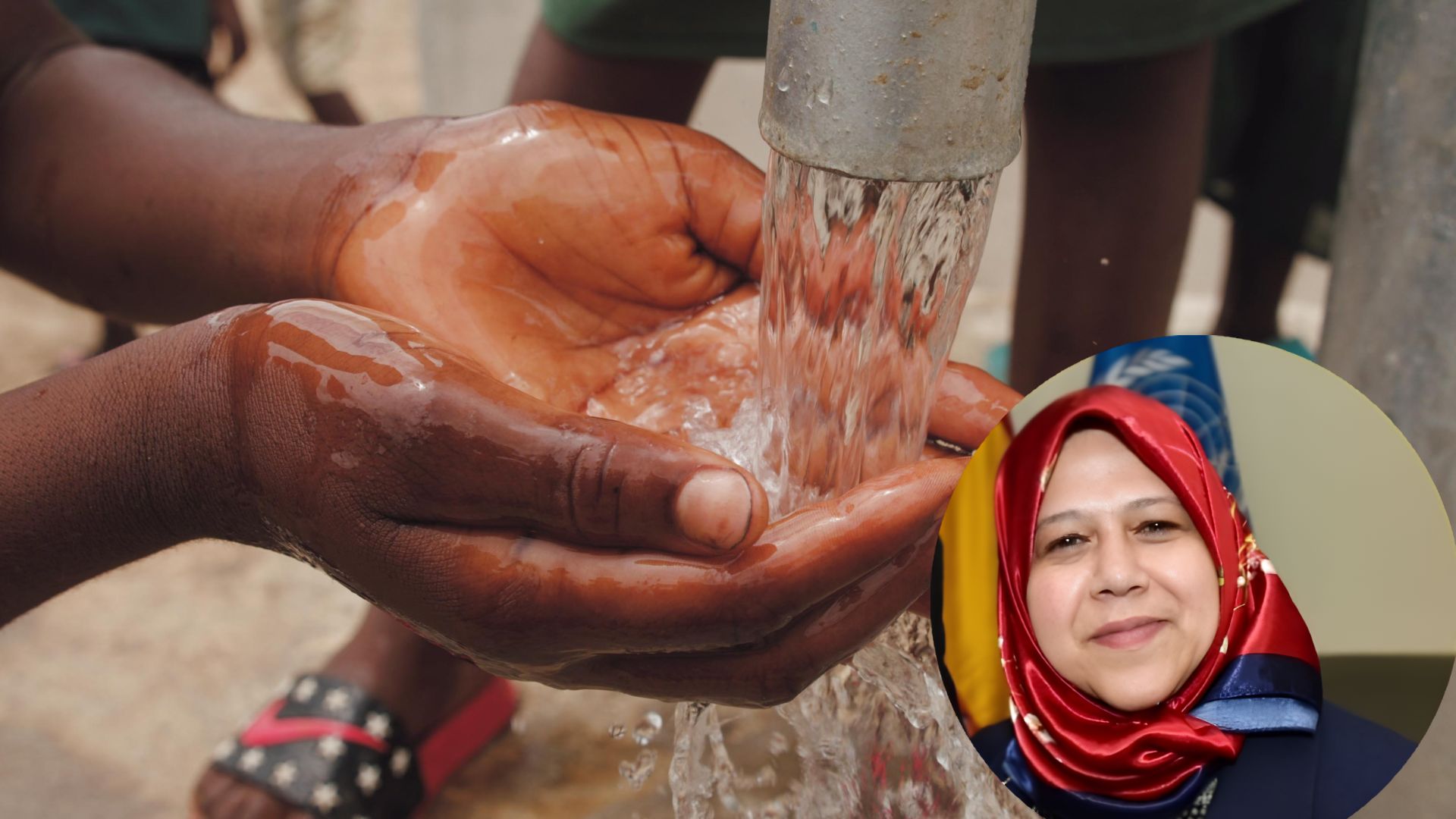
Muna Luqman had put her birds to bed before our conversation. They usually join her Zoom meetings, she explained. When I mentioned that my daughter has two cockatiels, she wanted to be sure she had heard correctly. “You have cockatiels?” Yes. “Okay, we’re besties now.”
Muna, who now lives in Cairo, Egypt, has lived through airstrikes, street fighting, and sieges in her home country of Yemen, on the southern end of the Arabian Peninsula. For more than a decade, she has helped communities get water, supported displaced families, and organized women across political divisions. She began receiving awards before she thought of herself as a peacebuilder.
“People would say, you’re a peacebuilder, you’re a climate activist,” she says. “But I wasn’t doing climate change, I was trying to help people and mediate between water and tribes.”
She laughs often during our conversation, including as she describes her frustrations with institutions she has spent years trying to influence. After years of criticizing the United Nations, she spent three years working inside it, trying to bring more people from Yemeni communities into discussions about their country’s future.
When I ask what peace means to her now, she begins with the people living through the conflict. “I think it’s just more dignity and safety for the people,” she says. “For me, it’s just food on the table for the people and just preserving their dignity.”
Pay the Salaries. Open the Roads.
Muna talks about salaries and livelihoods as part of preventing violence. People need ways to support their families, and communities need functioning economies. Armed groups gain power when they can control access to necessities or offer income that people cannot find elsewhere.
“If you ask people, they will say, how do you stop the war in Yemen? They will say, pay the salaries, the economy. They will say, open the roads, open the airports.”
She describes water and salaries being weaponized, alongside food and humanitarian aid. Restoring access can weaken the messages armed groups use to recruit fighters and sustain the war. “It’s not just about relieving the suffering,” she says. “It’s about taking the power away from these warlords.”
When I ask what she has had to unlearn about peace, she welcomes the question. “Nobody’s ever asked me this question,” she says.
“I had to unlearn that the idea of peace being designed or being a product of negotiation tables is not correct.”
Muna recognizes agreements as part of the process, but she has watched fighting continue after the handshakes and announcements. Her questions follow people beyond those moments, into whether they can move safely, earn a living, and have access to what they need.
“If a ceasefire is not bringing relief to the people, and it’s not stopping the bloodshed, it’s not a ceasefire, I’m sorry,” she says.
When Peace Needs Water
In Taiz, water was scarce before the current conflict. Then opposing forces took control of different parts of the city and used access to water to pressure people. Displaced families sought shelter in communities already struggling with limited supplies, where a local dispute over water could become an armed conflict.
Through Food4Humanity’s Water for Peace initiative, Muna and others mediated with local authorities, repaired damaged equipment and wells, and established community committees that included women and young people to oversee the water for 120,000 families. Her work has earned international acclaim, including being named a 2026 Water Defender by The Fuller Project.
In Al-Haymatin, her team mediated within a community where people had been fighting and repaired a water station, restoring water for more than 10,000 families. They brought in technicians and people trusted for their neutrality. Muna’s own reputation as a humanitarian helped them gain access and cooperation.
Later, at a gathering where she described the project, someone familiar with the area interrupted her. “But they’re fighting there,” he said.
“They’re not anymore,” Muna replied.
Girls had often been responsible for fetching water, sometimes facing harassment along the way. Muna says some had died falling into wells. After restoring water, her team rehabilitated the nearest girls’ school. Then the boys began asking for schools, too, and the team supported them, offering another possibility for children vulnerable to recruitment as soldiers. Community members took part in managing the water and the livelihoods that depended on it.
When we talk about thirst and how quickly it can change the way a person feels, Muna remembers a recent trip to the UK. She usually carries water wherever she goes, but friends had teased her about her bottles and frequent bathroom stops. While they were doing a lot of walking, she stopped bringing one. She became severely dehydrated and remembers feeling tense and unusually aggressive before she understood why. “So never again,” she says. “I’m going to take my water bottle everywhere.”
“So imagine displacement,” she says. People are living without salaries, facing extreme temperatures without reliable water or electricity. Even a brief experience of thirst can make it easier to understand how tensions over water can erupt into violence, especially where access is deliberately withheld and people have no way of knowing when relief will come.
“I think helping communities help themselves is a part of peace,” Muna says. “I think reviving livelihoods is peace. Humanizing security, checkpoints, police stations, bringing back the humanitarian element to all of these institutions is very important. This is real peace.”
We Brought Our Own Chairs
Years ago, Muna traveled to peace talks in Geneva with three other Yemeni women as an independent delegation. Excluded from the formal negotiating table, they secured their own conference room inside the United Nations and invited diplomats to meet them there.
“When we went to Geneva, we brought our own chairs,” she says. “We didn’t need the table.”
She has grown tired of discussions that stop at whether women should have seats. “It’s not just the women, it’s women, it’s tribes, it’s youth as well. It’s the community. The whole community is missing,” she says. “And when the community is missing, that means that these warlords are able to mobilize them on the ground and continue fueling the conflict.”
Muna has watched armed groups gain recognition while people working peacefully struggle for support and protection. She rejects the argument that women cannot affect a conflict because they do not have guns. “We were able to stop guns and people from fighting many, many times,” she says. “Imagine if we were supported, legitimized.”
The possibility of bringing excluded people into formal processes drew her to work inside the UN. A new inclusion strategy and a colleague with a civil society background gave her reason to try, though she made clear that joining would not end her criticism. “I told them at the beginning, listen, I’m still an activist.”
Over three years, she helped bring together nearly 1,000 people from Yemen and the diaspora, across generations and sectors. She says the inclusion project was later cut during budget reductions. The experience left her frustrated with institutional structures that resisted the changes the strategy required.
She also recognizes how much local peacebuilders and community organizations need international resources and expertise. Muna wants that support to reach people whose knowledge can help prevent violence, including those who recognize danger before it becomes an international crisis.
“When they’re overlooked, we’re missing the early warnings, we’re missing the prevention,” she says.
“We’re Here to Protect Each Other”
The women who came together through Yemen’s Women’s Solidarity Network brought different political affiliations and ideas about their country’s future. Some stood on opposite sides of divisions that had fractured Yemen. Trust took time and emotional investment, but Muna says she eventually came to trust women whose political positions remained opposite her own.
“We grew together, and the shared common value was that we’re here to protect each other,” she says. “I don’t care if you believe in this. It’s okay.”
They worked horizontally, which came with its own challenges. “Everybody wants to be the leader,” she says, laughing.
Their relationships helped them understand the needs of different communities. People in Taiz needed roads opened, while communities in Marib faced displacement pressures. Those differences informed a roadmap for peace with recommendations drawn from the places the women knew.
As the network’s influence grew, political leaders and groups began responding to its statements. Some sent messages they wanted included. Muna says crafting a statement can take forever as she tries to reflect people’s needs across divisions without making the network an advocate for warlords.
“It’s about the people’s needs from all sides,” she says. That position has brought criticism from people who want her to choose a faction. “I don’t care anymore about that,” Muna says. “Just care about the people.”
Whose Knowledge Counts
A few days before our conversation, a researcher approached Muna for an anonymous interview. She had participated in such interviews before, including when anonymity provided necessary protection. This time, she asked whether her insights and analysis could carry her name.
The researcher declined, citing university ethics requirements. Muna respected the decision and shared some information because she wanted the knowledge to travel, but the exchange stayed with her. Women peacebuilders contribute analysis to researchers and policymakers, she says, while institutions elsewhere receive funding and recognition.
She wants researchers to document local knowledge and acknowledge the people who hold it. She asks the same care of media organizations. Muna has heard Yemen described through accounts that overlook armed factions, differences between regions, and the experiences of people who have lived through the conflict.
“One person with the right knowledge for me is much more powerful than somebody who has a media outlet and is spreading the wrong information about a country he doesn’t know anything about,” she says.
“I Don’t Want You to Lose Hope”
A Dutch friend had messaged Muna that day, overwhelmed by conflicts around the world. Muna understood. She had also seen breakthroughs, places where fighting had stopped and people had found ways to work together.
“I definitely, definitely, definitely believe in the humanity of people,” she says.
She knows how deliberately that humanity can be attacked. She describes hate speech used to turn young people against one another and fear used to mobilize them as fighters. She named Food4Humanity with those young people in mind.
When I ask what people far from Yemen can do, Muna encourages them to learn from people who know the communities and support local humanitarian organizations, whether by sharing their work or offering their time. The day before we spoke, someone had contacted her about helping Food4Humanity with fundraising. “I was just so happy that somebody around the world who doesn’t even know me wants to support.”
As we finish our conversation, she wonders whether she has overwhelmed me. She has spoken candidly about what she has lived through and the frustrations of spending years working for peace while watching people’s needs go unanswered. Before we say goodbye, she adds, “I don’t want you to lose hope.”
I definitely, definitely, definitely believe in the humanity of people.
Connect with Muna and follow her work on LinkedIn, X/Twitter, and Instagram.
This profile is part of our Peacebuilder Series. Read the main article, What Does it Mean to Practice Peace Now? and meet the other peacebuilders in the series: Ben Bowler, Jon Ramer, and Deborah Moldow.
For a look at peacebuilding in practice, What Peace Looks Like When People Are Already Building It shares powerful work from within four conflict zones.


